Guide · Updated
Fake Telegram Subscribers: Is a Crypto Channel's Audience Bought?
How to spot bought subscribers and fake engagement on a crypto Telegram channel by comparing views, reactions and growth over time. No tools needed.
A big subscriber number does a lot of selling for a crypto Telegram channel. It says “lots of people trust this”. It’s also the easiest number on Telegram to fake. Subscribers, views and reactions can all be bought, and for a signal or VIP channel, looking popular is part of the sales pitch.
You can’t prove a channel bought its audience just by looking at it. You can, though, notice when the numbers don’t behave the way real audiences behave. This guide shows what to compare. It’s part of our guide on finding good crypto Telegram channels.
Why channels inflate their numbers
It’s not always a scam. Some admins buy a starting audience because nobody joins an empty channel. But in crypto, inflated numbers usually serve a sale:
- A signal channel wants you to think thousands of people profit from its calls, so you’ll pay for VIP.
- A pump group wants you to believe its “community” will push a coin up.
- A channel being sold or rented for advertising wants a higher price.
Whatever the reason, the effect on you is the same: the number on the page no longer tells you how many people actually read the channel.
The one rule: compare the channel with itself
You’ll find articles online that quote a “normal” views-to-subscribers percentage. Ignore them. Engagement varies hugely between channel types, languages and posting frequency, and nobody has a reliable benchmark for crypto Telegram as a whole.
What you can do is compare a channel with its own history. Real audiences are messy. Bought ones tend to be flat, sudden, or oddly consistent.
Signal 1: view counts that never move
Every channel post shows a view counter. Scroll through two or three weeks of posts and look at the numbers.
In a real channel, views vary. A breaking news post gets more than a routine update. Weekend posts behave differently from weekday ones. Older posts keep collecting views slowly, so a post from last month usually shows more than one from this morning.
Warning signs:
- Almost every post shows nearly the same view count, give or take a few.
- A post published ten minutes ago already has as many views as one from last week.
- Views on posts jump in round blocks, then stop.
Purchased views are often delivered in packages, which is why they can look strangely uniform.
Signal 2: views that don’t match the subscriber count
Look at the relationship between views and subscribers, then watch whether it changes over time. Two patterns are worth noticing:
- Huge audience, tiny reach. A channel with a very large subscriber count where posts consistently get only a small fraction of that in views. That’s typical when the subscriber base was bought: the accounts exist but nobody behind them reads.
- Reach that doesn’t grow with subscribers. The subscriber count doubled recently, but views per post are the same as before. Real new followers would show up in the views.
Neither proves anything on its own. Old channels collect inactive subscribers naturally, and Telegram channels with a long history often have lower reach for that reason. That’s why the comparison over time matters more than any single ratio.
Signal 3: reactions and comments from empty accounts
If reactions are enabled, tap them to see who reacted where Telegram shows it, and read the comments in the linked discussion group.
Things that look off:
- Many accounts with no photo, no username and random names.
- The same emoji reaction appearing in near-identical numbers on every post.
- Comments that say nothing specific: “Great signal!”, “Thanks admin”, “Best channel 🔥”, repeated across posts by different accounts.
- Comments that all arrive within a minute or two of posting, then nothing.
Real comment sections are uneven. Some people complain. Some ask a question nobody answers. Someone posts a loss. If every comment is praise, you’re probably reading a script.
Signal 4: growth in steps
You can’t see a channel’s growth chart unless you’re an admin, but you can sometimes infer it. Third-party Telegram analytics sites track public channels and show subscriber history. If you use one, look for:
- Vertical jumps of thousands of subscribers in a day, without a matching event (a viral post, a mention by a big account).
- A jump followed by a slow decline, which happens when bought accounts get cleaned out.
Without such a site, use the channel itself. If it regularly posts “We hit 50K!” milestones and the dates are very close together, compare that with the views on posts from the same period.
Signal 5: comments switched off
A channel can disable comments entirely. Plenty of announcement channels do this for good reasons: an exchange’s announcement feed isn’t a discussion space.
But for a signal or VIP channel that claims thousands of satisfied members, no comments means no visible complaints. Combine that with heavy promotion and you have a channel that controls everything you see about it.
What an honest big channel looks like
Size isn’t the problem. Some of the biggest channels in our directory are big because they’ve been useful for years. The Binance announcements channel is the largest channel we list, and its audience behaves like a real one: views swing with the importance of the post.
Even large signal channels can be honest about what they are. Our listing for Binance Killers notes it’s large and long-running, and also that the free calls are a teaser for a paid VIP and that results posts highlight winners more than losers. Big and promotional can both be true.
Why we barely score audience size
The About page explains our scoring: audience size is shown but barely affects the score. Member counts in our listings are copied from the public t.me page on the date shown. We don’t estimate them, and we don’t treat a big number as a quality signal. Big channels are not better channels.
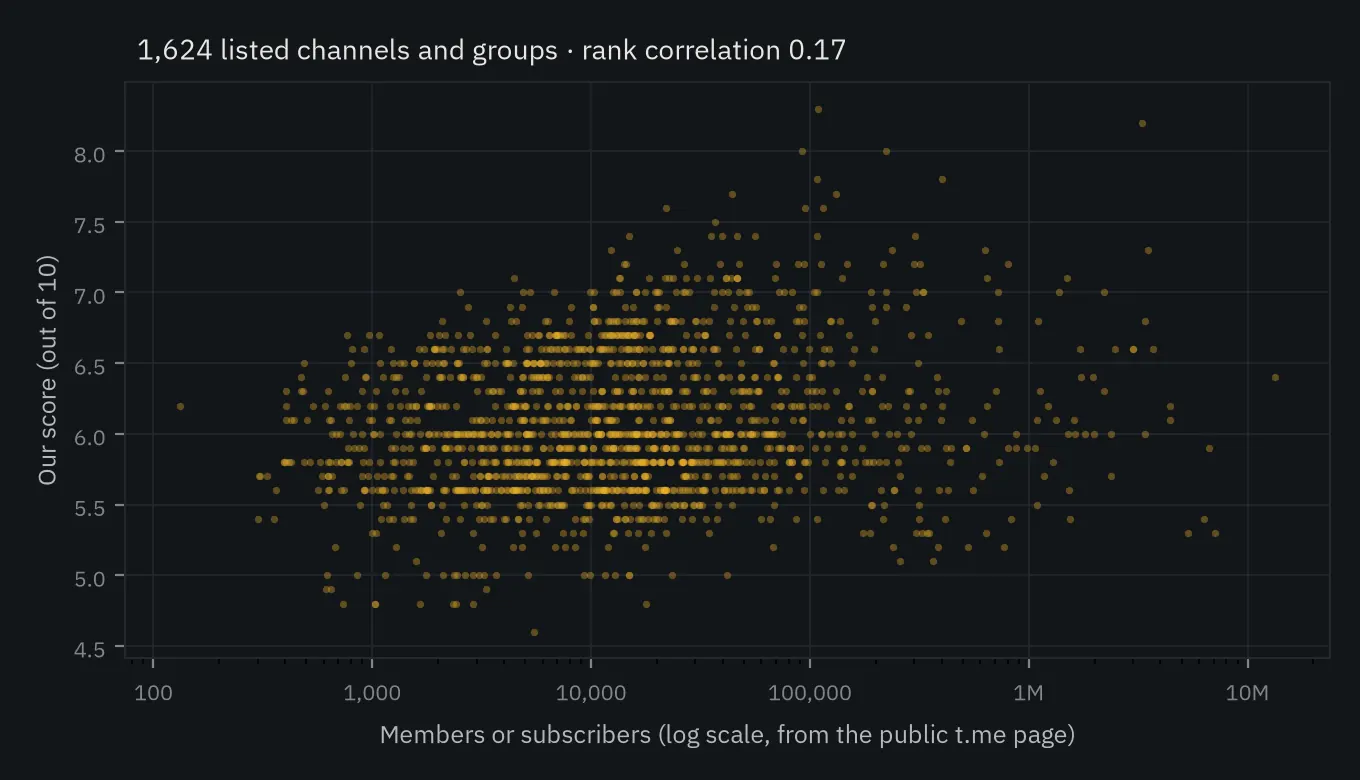
In our own data the link is weak. Listings with 1,000 to 9,999 members have a median score of 6.0; listings with a million or more have a median of 6.1.
What we weigh instead is usefulness, honesty (stop-losses, losing trades shown, no “100% accuracy” claims), upsell pressure, track record and safety. You can apply the same priorities yourself.
A five-minute audit
- Open the channel’s last 30 posts.
- Note the view count on each. Do they vary naturally?
- Compare views on the newest posts with posts a week or a month older.
- Open comments on three posts. Are they from real-looking accounts saying specific things?
- Check whether the subscriber count grew without views growing with it.
If two or more of these look wrong, treat the subscriber count as decoration and judge the channel only by what it posts. For signal channels, that means checking its calls yourself, which we explain in how to verify a signal channel’s track record.
Part of our series on crypto Telegram. Start with the overview: How to Find Good Crypto Telegram Channels (and Skip the Junk).