Guide · Updated
How to Spot a Pump-and-Dump Telegram Group Before You Buy
Countdowns, 'coin reveal' posts and 'buy and hold' orders: how crypto pump-and-dump groups on Telegram work, and the warning signs to check before you buy.
A pump-and-dump group tells its members to buy the same small coin at the same moment. The price jumps. Then people who bought earlier sell into that jump, and the price falls back, often below where it started. Most members end up as the people buying at the top.
Some groups are openly pump groups. Others look like normal signal channels or “gem hunting” communities. This guide shows how to recognise both before you put money in. It’s part of our guide to finding good crypto Telegram channels.
How a pump works from the inside
The mechanics explain why members lose.
- Announcement. The group posts a date and time: “Next pump Sunday 18:00 UTC. Exchange: X. Target: 300%+.”
- Countdown. Posts at 24 hours, 1 hour, 10 minutes, 5 minutes. Excitement builds.
- The reveal. At the exact time, a coin name or ticker appears, often as an image to slow down bots.
- The rush. Thousands of members try to buy at once on a thin market. The price spikes within seconds.
- The dump. Whoever knew the coin in advance (the organisers, VIP members who got the name “early”, or people who’d been quietly buying) sells into the spike.
- The aftermath. The price falls back. The group posts a screenshot of the peak and calls it a success. Members who bought at the peak are told to “hold”, because “the second wave is coming”.
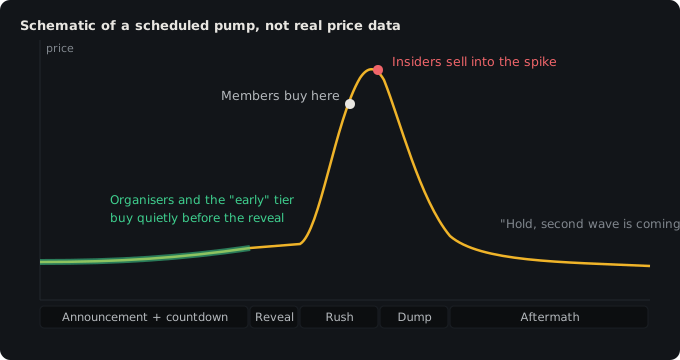
Being in the group doesn’t give you the information. The people who profit had it before the reveal.
Warning signs in open pump groups
These are easy to spot once you know them:
- Countdown timers to a “coin reveal” or “big signal”.
- “Buy and hold, don’t sell” instructions, or “selling early ruins it for everyone”.
- Targets of several hundred percent.
- Instructions to post about the coin on social media after buying, to “bring in outsiders”.
- Paid tiers that get the coin “seconds earlier”. That’s the tier that profits from the free tier.
- Chosen coins with low market cap and little trading volume, often on smaller exchanges.
Warning signs in disguised pump groups
Harder to spot are groups that call themselves “gem calls”, “100x hunters” or “early alpha”, and just post a new small coin every few days with excitement. Look for:
- Calls without a plan. No entry range, no stop-loss, no reason, just a ticker and rocket emojis. Compare with what a real signal needs in how to read crypto signals.
- Results only at the peak. “Up 400% since our call!” measured from a pre-call price nobody could buy at, to the highest wick.
- Admins who “already bought”. “I’m in, loading more.” They’re telling you they bought first.
- Paid promotions labelled as calls. Small projects pay channels to post about their token. If a channel doesn’t say a post is paid, you can’t tell.
- A contract address and urgency. “Buy now before CEX listing!” New tokens with copycat addresses are a separate problem; check how to verify a token contract address.
- Deleted posts. Calls that went badly quietly disappear. Scroll back and see whether the channel’s history has holes.
A quick check on any “call”
Before buying a coin a Telegram group just called:
- Look at the chart for the last few hours and days. Did volume and price already start rising before the call? Someone bought before you.
- Check market cap and liquidity. A coin worth a few hundred thousand dollars can be moved by a single group. On a decentralised exchange, check how much liquidity is in the pool and whether it’s locked.
- Check the holders. On a block explorer, look at the top holders. If a few wallets hold most of the supply, they can sell into your buying.
- Ask what the plan is. Where’s the stop? What’s the exit? If the answer is “hold”, you’re exit liquidity.
Why it’s not just risky but harmful
Coordinated pump-and-dumps are treated as market manipulation under the law of many countries, at least for regulated assets, and regulators have brought cases against organisers. Even where crypto rules are unclear, the structure means members as a group transfer money to organisers. Joining one doesn’t make you a victim of a hack; it puts you in a game where the house wins by design.
How these groups grow
Pump groups need a big audience, because their profit comes from the crowd buying. That’s why they push referral programmes, invite contests, and big subscriber numbers. Some of those numbers are bought. Use the checks in how to tell if a crypto Telegram channel’s audience is bought before trusting a “200K members” headline.
What to look for instead
If you want early information on small coins without being someone else’s exit, look for channels that:
- explain why a token is interesting, including the risks;
- disclose when a post is paid;
- show losing calls as well as winning ones;
- don’t have countdowns or reveals.
Pump-and-dump and “guaranteed profit” channels are on the list of things we decline when admins submit a channel, and our reviews flag upsell-heavy channels. The altcoin channels category is where we list channels that cover smaller coins; read each review note before joining. For research rather than calls, CoinMarketCap’s channel and on-chain data channels like CryptoQuant give you context without telling you what to buy.
The short version
If a group’s main event is a countdown, the people who benefit are the ones who don’t need the countdown. Skip it.
Part of our series on crypto Telegram. Start with the overview: How to Find Good Crypto Telegram Channels (and Skip the Junk).