Guide · Updated
How to Verify a Token Contract Address Before You Buy
Fake token contract addresses get posted in Telegram crypto groups constantly. How to find the real address, compare it properly and avoid copycat tokens.
On most blockchains, anyone can create a token with any name and any ticker. That means there can be dozens of tokens called the same thing, and only one is the one the project actually launched. The thing that tells them apart is the contract address: a long string like 0x followed by 40 characters on Ethereum-style chains, or a different format on Solana, TON and others.
In Telegram crypto groups, contract addresses are posted, reposted, pinned and replied to all day. Some of those addresses are wrong on purpose. This guide shows how to check one before you buy. It’s part of our guide to finding good crypto Telegram channels.
How fake addresses reach you
- Reply-guy scam. Someone replies to a project announcement in a group with “CA: 0x…” before the real admin does. People copy the first one they see.
- Fake project groups. A copy of the project’s group with the same name and photo, and a pinned message with a fake address.
- Edited messages. A message gets edited after people saw the real address and quoted it. Telegram marks edited messages as “edited”, but few people look.
- Launch-day chaos. A new token launches, the real address isn’t announced yet, and copycats deploy tokens with the same name minutes earlier.
- Address poisoning. Different but related: a scammer sends you a tiny transaction from an address that looks like one you’ve used, hoping you copy it from your history later.
Step 1: get the address from at least two official sources
Never take an address from a chat message alone, even a pinned one. Look for it in at least two of:
- The project’s official website (typed or bookmarked, not clicked from a chat).
- The project’s official X account, ideally a pinned post.
- The project’s documentation.
- The listing page on a major data aggregator such as CoinMarketCap or CoinGecko, where the contract is shown on the token page. Remember aggregators can list several tokens with the same name, so match the project page, not just the ticker.
- The token page on an exchange that lists it, if it’s listed.
If the sources disagree, stop.
For the project’s Telegram itself, use the same methods as for exchanges in how to verify an official exchange Telegram channel: follow the link from the website rather than searching by name.
Step 2: compare the whole address
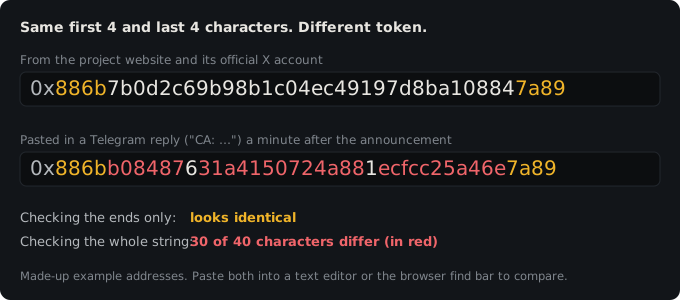
People check the first four and last four characters. Scammers know that, and they generate addresses that match on the ends. Compare the full string:
- Paste both addresses into a plain text editor, one under the other, and check them character by character.
- Or paste one into your browser’s find bar on the page with the other.
It takes 20 seconds.
Step 3: check the right chain
The same project can have tokens on several chains, each with a different address. And an address that’s correct on one chain may point to a completely different token, or nothing, on another. Make sure the chain in your wallet or swap app matches the chain the official source names.
Step 4: look at the token on a block explorer
Open the address on the chain’s block explorer (Etherscan for Ethereum, BscScan for BNB Chain, Solscan for Solana, Tonviewer or Tonscan for TON, and so on). Check:
- Name and symbol match the project.
- Holders. A real, established token has many holders. A copycat launched an hour ago has very few.
- Creation date fits the project’s launch.
- Verified source code on explorers that support it. Not a guarantee, but missing code on a supposedly big token is odd.
- Explorer warnings. Explorers sometimes label known phishing or fake tokens.
- Top holders. If one or two wallets hold most of the supply, they can dump on you.
Step 5: test the swap carefully
On a decentralised exchange:
- Import the token by address, not by searching the name.
- Read any warnings the interface shows about unknown or unverified tokens.
- Check liquidity. A pool with very little liquidity means big price impact and possibly no way out.
- For new tokens, try a small amount first and confirm you can sell, too. Some scam tokens are coded so that buyers can’t sell (“honeypots”).
What about bots that buy for you?
Telegram trading bots let you paste a contract address and buy in a few taps. They’re popular for new tokens and they’re fast, which is exactly why mistakes are costly. The bot buys whatever address you give it. Some bots also hold your private keys. If you use one, follow its official update channel, for example Maestro’s update log, and read crypto Telegram bots and what never to give them before connecting anything.
Approvals: the risk after the buy
Buying or interacting with a token often means signing a token approval, which lets a contract spend tokens from your wallet. Malicious contracts can use broad approvals to drain wallets later.
- Read what you’re signing. If your wallet says “unlimited” approval to an unknown contract, think twice.
- Periodically check approvals with a block explorer’s token approval tool and revoke ones you no longer need.
- For anything experimental, use a separate wallet, as explained in how to set up a burner wallet for airdrops.
Anti-phishing communities like Scam Sniffer and security firms like PeckShield regularly post warnings about drainer contracts and fake tokens. You’ll find more of them in our crypto security channels.
Pump groups and fresh tokens
Many “new token” calls in Telegram groups come with a contract address and a lot of urgency. Even if the address is correct, the token may be part of a coordinated pump. See how to spot a pump-and-dump Telegram group.
If you bought the wrong token
Copycat tokens are often worthless and can’t be sold. There’s usually nothing to recover. Revoke any approvals you gave, and be ready for “recovery experts” in your DMs. They’re another scam, explained in crypto recovery scams on Telegram.
Checklist
- Address from two official sources, not a chat message.
- Full address compared, not just the ends.
- Right chain.
- Block explorer: name, holders, creation date, warnings.
- Import by address, small test, check you can sell.
- Watch approvals.
A minute of checking is a lot less than the cost of a copycat token.
Part of our series on crypto Telegram. Start with the overview: How to Find Good Crypto Telegram Channels (and Skip the Junk).