Guide · Updated
How to Read a Crypto Signal: Entry, Targets, Stop-Loss, Leverage
What each line of a Telegram crypto signal means, how to work out risk-to-reward, and what's missing from a bad call. Three example signals broken down.
A crypto signal is a trade idea packed into a few lines: which coin, which direction, where to get in, where to take profit, where to give up. Signal channels on Telegram post them in a fairly standard format, and once you can read that format, you can also see what a call leaves out.
This guide takes three example signals apart line by line. The coins and prices below are made up for illustration. They’re not recommendations and they don’t come from any real channel. This is part of our guide to finding good crypto Telegram channels.
Example 1: a complete signal
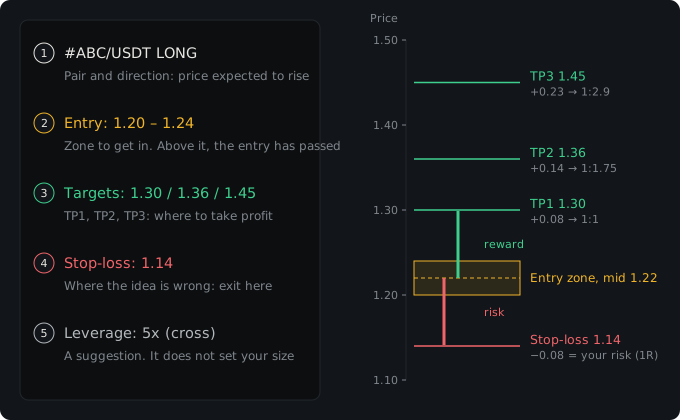
#ABC/USDT  LONG
Entry: 1.20 – 1.24
Targets: 1.30 / 1.36 / 1.45
Stop-loss: 1.14
Leverage: 5x (cross)
Line by line:
#ABC/USDT is the trading pair. You’re trading ABC priced in USDT. Make sure the pair exists on your exchange, and on the right market: spot and futures prices can differ slightly.
LONG means the channel expects the price to go up. SHORT means it expects the price to fall. Shorting is normally done on futures or margin, not plain spot.
Entry: 1.20 – 1.24 is the zone where the channel thinks buying makes sense. If the price is already at 1.32 when you read it, the entry has passed. Chasing it changes the whole trade, because your stop-loss is now further away and your first target is already behind you.
Targets (TP1, TP2, TP3) are take-profit levels. Many traders close part of the position at each target: some at TP1, more at TP2, the rest at TP3. Channels count “TP1 hit” as a win even if TP2 and TP3 never come, which matters when you check their results.
Stop-loss: 1.14 is where the trade idea is wrong and you exit with a loss. A stop-loss is what turns a guess into a plan with a known risk.
Leverage: 5x is the channel’s suggestion for a futures position. It is not a requirement, and it says nothing about how much of your money you should use. We cover that in following futures signals: position size and leverage.
Cross refers to the margin mode. In cross margin, your whole futures balance backs the position; in isolated margin, only the amount you allocate is at risk. Beginners are usually better served by isolated.
Working out risk-to-reward
Risk-to-reward (R:R) compares how much you can lose with how much you can gain. Take the middle of the entry zone, 1.22:
- Risk: 1.22 − 1.14 = 0.08 per coin
- Reward to TP1: 1.30 − 1.22 = 0.08, so 1:1
- Reward to TP2: 1.36 − 1.22 = 0.14, about 1:1.75
- Reward to TP3: 1.45 − 1.22 = 0.23, about 1:2.9
A call where TP1 is about as far as the stop-loss means a “TP1 win” barely covers one loss. Keep that in mind when a channel advertises a high win rate based on TP1 hits.
Leverage doesn’t change R:R. It multiplies both sides.
Example 2: a call with something missing
🚀🚀 #XYZ/USDT LONG 🚀🚀
Buy: 0.050 – 0.054
TP: 0.060 – 0.070 – 0.090 – 0.120
Leverage 20x
DON'T MISS THIS ONE
What’s wrong:
- No stop-loss. You have no idea where the idea is wrong. Some channels say “stop-loss will be posted later” or “we don’t use stops, we manage the trade”. Either way you can’t calculate your risk. On our signals category page we put it plainly: a call without a stop-loss is not a signal.
- An 8% entry zone. From 0.050 to 0.054 is a wide range. Your result depends heavily on where in that range you got filled.
- Targets of +140% with 20x leverage, with no stop. That’s a set-up for liquidation, not a trade plan.
- Urgency and emoji. “Don’t miss this one” is marketing. It doesn’t make the call better.
Channels sometimes post the stop-loss only in their paid VIP, leaving free members with half a signal. If that’s the case, the free calls aren’t really usable on their own. More on that in free vs VIP crypto signal groups.
Example 3: a spot call
SPOT  #DEF
Buy zone: 3.40 – 3.55
Targets: 3.90 / 4.30
Invalidation: daily close below 3.10
No leverage, no long/short. You buy the coin and hold it. Note the stop is written as invalidation on a daily close: the idea is wrong only if a daily candle closes below 3.10, not if the price briefly wicks there. That’s a legitimate style, but it means you have to watch daily closes or set an alert, because a regular stop order on your exchange would trigger on the wick.
Other terms you’ll see
- CMP: current market price. “Entry CMP” means buy now.
- DCA: dollar-cost averaging. Buying in several pieces across the entry zone.
- Move SL to entry / BE: once TP1 is hit, the channel suggests moving your stop to your entry price (break-even), so the rest of the trade can’t lose money.
- Close manually / close at market: the channel suggests exiting before any target or stop.
- Scalp / swing: a short trade (minutes to hours) versus a longer one (days to weeks).
- Limit / market order: a limit order waits for your price; a market order fills immediately at whatever price is available.
Things to check before acting on any call
- Is the entry still valid? If the price has moved past the zone, skip it.
- Is there a stop-loss? If not, set your own or skip it.
- What’s the R:R to TP1? If it’s below 1:1, a lot of wins are needed to make money.
- How much are you risking? Decide in money, not in leverage. A common rule is risking a small fixed percentage of your account per trade.
- Is the coin liquid? Small coins with thin order books can move straight through your stop.
- Who posted it? Make sure it came from the real channel, not a copy, and that the message wasn’t edited after the fact.
Reading the channel, not just the call
One good call tells you nothing. What tells you something is the last thirty calls, all of them, including the ones that hit the stop. We explain how to do that in how to verify a signal channel’s track record.
Want to see channels that post calls in the full format? The best free crypto signals Telegram groups list is ranked on exactly these things: whether calls come with a stop-loss, whether losing trades are posted, and how hard the upsell is.
Part of our series on crypto Telegram. Start with the overview: How to Find Good Crypto Telegram Channels (and Skip the Junk).