Guide · Updated
Following Futures Signals: Position Size, Leverage and Liquidation
How to size a futures trade from a Telegram signal: risk a fixed amount, use the stop-loss distance, and keep liquidation well beyond your stop. Worked example.
Most futures signals on Telegram end with a line like “Leverage: 10x” or “20x cross”. A lot of people read that as an instruction: put in money, set 10x, done. That’s how accounts get liquidated on trades that would have been fine.
Leverage in a signal is the channel’s style. How much you can lose is something you set, through position size. This guide shows how to work it out from the stop-loss, with a worked example. It’s part of our guide to finding good crypto Telegram channels. Nothing here is financial advice; futures trading can lose you more than you expect, and you should read our disclaimer.
The idea in one sentence
Decide how much money you’re willing to lose if the stop-loss is hit, then choose a position size that loses exactly that much at the stop. Leverage is just what lets you open that position with less margin.
Step 1: pick your risk per trade
Choose a fixed share of your trading account that you’ll lose on a stop-out. Many traders use something like 1% or 2%. The exact number is yours to choose, but it should be small enough that a run of losses, which every strategy has, doesn’t wreck the account.
Example: a 1,000 USDT futures account, risking 1% per trade = 10 USDT at risk.
Step 2: measure the distance to the stop-loss
Take an example signal (made-up numbers):
#ABC/USDT LONG
Entry: 2.00
Stop-loss: 1.90
Targets: 2.10 / 2.20 / 2.35
Leverage: 10x
The stop is 0.10 below the entry. As a percentage: 0.10 ÷ 2.00 = 5%.
Step 3: calculate the position size
Position size = money at risk ÷ stop distance (as a fraction)
10 USDT ÷ 0.05 = 200 USDT position.
If the price falls from 2.00 to 1.90, a 200 USDT position loses 5%, which is 10 USDT. That’s your planned loss. Fees and slippage add a little; include them if you want to be precise.
In coins: 200 ÷ 2.00 = 100 ABC.
Step 4: now choose leverage
Leverage only affects how much margin the exchange locks up for that 200 USDT position:
| Leverage | Margin needed for a 200 USDT position |
|---|---|
| 1x | 200 USDT |
| 2x | 100 USDT |
| 5x | 40 USDT |
| 10x | 20 USDT |
Your loss at the stop is 10 USDT in every row. What changes is how close your liquidation price is.
Step 5: check where liquidation is
The liquidation price is where the exchange closes your position because your margin can’t cover the loss. Roughly speaking, with isolated margin and higher leverage, liquidation sits closer to your entry. As a rough guide, at 10x it’s a bit under 10% away, at 20x a bit under 5%, before fees and the exchange’s maintenance margin requirements. Your exchange shows the exact estimated liquidation price before you confirm the order. Always look at it.
The rule: liquidation must be well beyond your stop-loss.
In our example, the stop is 5% below entry. At 20x isolated, liquidation would be roughly 5% below entry too, which means you could be liquidated at or before your stop, losing your whole margin plus a liquidation fee. At 5x or 10x, liquidation is far enough below the stop that the stop triggers first.
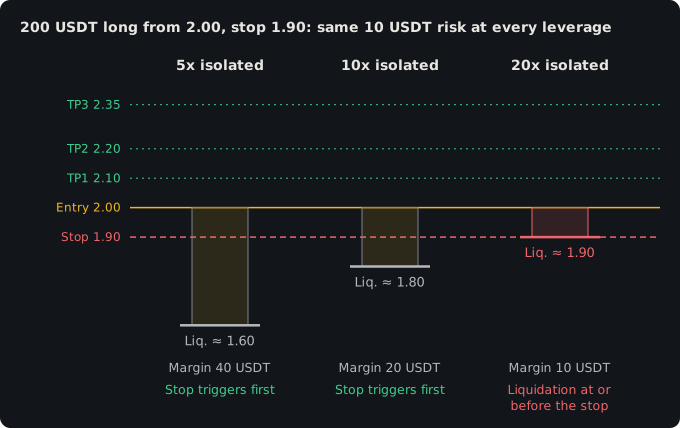
So the “20x” in a signal can be fine for one trade and dangerous for another. It depends on where the stop is.
Isolated or cross margin?
- Isolated margin: only the margin assigned to the position is at risk. If it’s liquidated, the rest of your futures balance is untouched.
- Cross margin: your whole futures balance supports the position. Liquidation is further away, but a bad trade can eat into everything.
Signals often say “cross”. For beginners, isolated with a correctly sized position is usually the safer default, because a mistake stays contained.
The mistakes that blow accounts
Using the signal’s leverage with your whole balance. 500 USDT at 20x is a 10,000 USDT position. A 5% move against you wipes it.
No stop-loss. If the signal doesn’t include one, you can’t size the trade. Either set your own or skip it. More in how to read crypto signals.
Moving the stop further away. If you widen the stop, your loss grows beyond what you planned. Recalculate or don’t do it.
Late entry. If the price has already moved toward TP1, your stop is now further away in percent. Using the same position size means risking more than planned.
Adding on losers. “DCA the entry” sounds harmless but adds size as the trade goes wrong. Plan any DCA levels in advance and include them in the risk.
Too many trades at once. Five open positions each risking 1% is 5% at risk, more if they’re correlated, which crypto pairs often are.
When a channel’s leverage is a warning sign
Look at the channel’s typical stop distance and leverage together. If it routinely posts stops 8–10% away with 25x leverage, the numbers don’t fit: liquidation comes before the stop. That’s not a trade plan, it’s a gamble presented as one. Channels that hide the leverage in a separate post, or only reveal it in the VIP, deserve the same scepticism.
Also notice who benefits from high leverage. Channels earning exchange referral commission get paid on trading fees, and bigger leveraged positions mean bigger fees. We explain that model in how “free VIP with our exchange link” groups work.
Quick reference
- Risk per trade: a fixed small % of your account.
- Stop distance: (entry − stop) ÷ entry.
- Position size: risk ÷ stop distance.
- Leverage: whatever gives you enough margin, as long as liquidation is well beyond the stop.
- Check the exchange’s liquidation estimate before confirming.
Before you follow anyone
A position sizing rule protects you from a bad trade. It can’t protect you from a bad channel. Audit the channel’s past calls first, using how to verify a signal channel’s track record. Our futures category lists futures channels with review notes on whether calls carry stops and how leverage is presented, and the best crypto futures Telegram channels list is a shorter starting point.
Part of our series on crypto Telegram. Start with the overview: How to Find Good Crypto Telegram Channels (and Skip the Junk).